
Video Call API Pricing: Cost and Usage Model Explained
TL;DR: Most video call APIs bill participant minutes, not sessions. A one hour call with ten people is 600 billable minutes, not 60. That single misunderstanding is behind most surprise invoices. Recording storage, resolution multipliers, and retention add more on top. Model your real usage before you compare headline rates, because the rate is the […]
Zoom Meeting API Alternative: A Comparison for Backend Teams
TL;DR: Teams usually leave Zoom’s Meeting API for one of three reasons: a daily rate limit that breaks batch scheduling, no self-hosted deployment option, or jurisdiction requirements a US-headquartered provider cannot satisfy. If none of those apply to you, Zoom’s API is mature and well documented. If one does, no feature comparison will fix it. […]
In-App Video Calling API: Architecture and Use Cases

TL;DR: In-app video calling means the call happens without the user leaving your product. It suits on-demand conversation between people who are already interacting, such as marketplaces, telehealth, and support. It is the wrong pattern for scheduled meetings, where a join link is simpler, cheaper, and works everywhere. In-app video calling is the most demanding […]
Self-Hosted Video Conferencing API: What It Solves and What It Costs

TL;DR: A self-hosted video conferencing API runs on infrastructure you control, so meeting data never reaches a third party and no foreign government can compel access to it. There are two routes: operate an open-source stack yourself, or deploy a commercial platform on-premise. The second keeps the sovereignty benefit without requiring in-house WebRTC engineers. Self-hosting […]
What Is a Video Chat SDK? Definition, Scope and Alternatives
TL;DR: A video chat SDK is a client library that puts live video inside your own application, usually alongside text chat and presence. You get complete control of the interface and you own it permanently. If your product only needs scheduled meetings rather than in-app conversation, a meeting API does the job in a fraction […]
What Is WebRTC? The Standard Behind Every Video Platform
TL;DR: WebRTC is an open standard built into browsers that lets devices send audio, video, and data to each other directly, encrypted by default. It powers essentially every modern video platform. It is a transport capability, not a product, which is why saying a tool is built on WebRTC tells you almost nothing about it. […]
What Is an SFU in Video Conferencing? A Plain Explanation
TL;DR: An SFU is a server that receives one video stream from each participant and forwards copies to everyone else. It is why modern video calls scale past a handful of people. Each person uploads once regardless of group size, which keeps upload bandwidth flat while download grows with the number of participants. Almost every […]
What Is TURN in WebRTC? The Server That Decides Your Bandwidth Bill
TL;DR: TURN is a relay server that carries video between two people when they cannot connect directly. STUN only helps them find each other and costs almost nothing. TURN carries the actual media, which makes it the expensive part of running video infrastructure. Estimates of how many calls need it range from around 15 percent […]
Microsoft Teams Meeting API Alternative: What Backend Teams Should Know
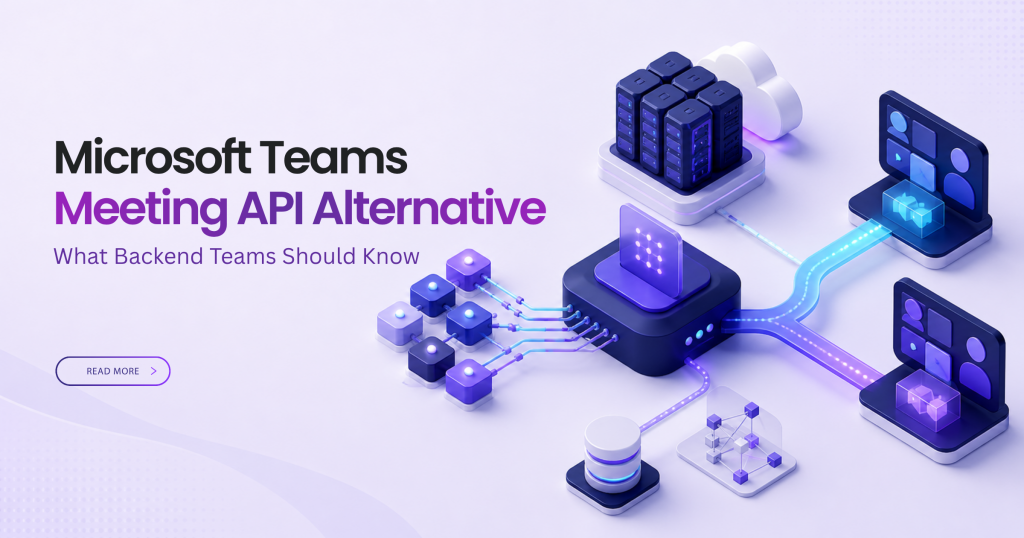
TL;DR: Creating Teams meetings programmatically means Microsoft Graph, which assumes every participant lives in your Microsoft tenant. That works well internally and becomes awkward for external users, multi-tenant products, and anyone needing meeting data outside Microsoft’s cloud. A standalone meeting API avoids the tenant dependency entirely. If your organisation runs on Microsoft 365, using Teams […]
Best Video Call API in 2026: An Evaluation Framework, Not a Ranking

TL;DR: There is no single best video call API, because the category contains two different products serving different needs. Ranked lists hide that. Score vendors yourself against five weighted criteria: category fit, scale ceiling, access control, cost at your real volume, and deployment options. Category fit alone eliminates most of the market before you look […]