
Quick Answer: The Best Zoom Alternatives
The 8 best Zoom alternatives in 2026 are Convay, Cisco Webex, Microsoft Teams, Google Meet, Jitsi, OpenTalk, Pexip, and Slack Huddles. For enterprise and government organizations that require data sovereignty, GDPR compliance, or large-scale webinar support, Convay is the strongest choice. For organizations already running on Microsoft 365, Teams is the most integrated option. For free open-source deployment, Jitsi and OpenTalk both offer fully self-hosted alternatives with no vendor data processing.
| Platform | Best For | Free Plan |
|---|---|---|
| Convay | Enterprise, government, large-scale webinars | Yes, unlimited seats |
| Cisco Webex | US federal agencies, DISA-certified environments | Yes, limited |
| Microsoft Teams | Microsoft 365 organizations | Yes, with M365 |
| Google Meet | Small teams, Google Workspace users | Yes, 1-hour groups |
| Jitsi | Open-source self-hosted deployment | Yes, fully free |
| OpenTalk | European public sector, GDPR-sovereign | Yes, open-source |
| Pexip | Regulated enterprise, hybrid infrastructure | No |
| Slack Huddles | Teams already using Slack for messaging | Yes, with Slack |
Why Organizations Are Replacing Zoom in 2026
Organizations replace Zoom in 2026 primarily because of data sovereignty conflicts, rising enterprise costs, and the limitations of a platform built for team meetings rather than large-scale institutional events.
The clearest signal of the shift is France. In January 2026, the French government announced that 2.5 million civil servants would stop using Zoom, Microsoft Teams, Webex, and GoTo Meeting by 2027, replacing them with sovereign tools hosted on French government infrastructure. This is not a procurement preference. It is a legal response to a structural incompatibility between the US Cloud Act and EU data protection law.
The Cloud Act gives US authorities the power to compel any US-owned technology company to hand over data stored anywhere in the world, including data on EU servers. The GDPR obligates EU organizations to prevent exactly that kind of foreign government access to EU citizen data. Any US-hosted video conferencing platform faces this conflict. No Data Processing Agreement resolves it. For public sector organizations, regulated enterprises, and international bodies, this has moved from a compliance footnote to an active procurement barrier.
Beyond the legal question, enterprise and government buyers are increasingly running events and all-hands sessions at scales that require more than a repurposed team meeting tool. Running a government townhall, an international NGO conference, or an enterprise all-hands for thousands of participants requires purpose-built webinar infrastructure, not a meeting platform with a webinar add-on.
How We Evaluated These Zoom Alternatives
These eight platforms were evaluated against the criteria that matter most for enterprise, government, and large-event use cases. Consumer-focused criteria like gamification, casual hangout rooms, or gaming integration were excluded because they are irrelevant to institutional buyers.
The evaluation criteria are as follows.
- Data sovereignty and hosting architecture. Where is meeting data stored, processed, and under what legal jurisdiction? Is on-premise or national cloud deployment available? Does the organization hold its own encryption keys, or does the vendor hold them?
- Security architecture. Is end-to-end encryption on by default? How is identity-based access enforced? Are recording and transcript storage governance controls available to administrators?
- Large-scale webinar performance. Can the platform reliably host events with thousands of simultaneous participants? Does it support moderated Q&A, live polling, real-time translation, and AI captions under load, or only in small test environments?
- AI meeting intelligence. Does the platform transcribe, summarize, and extract action items? Critically, does AI processing occur within the organization’s data boundary, or on shared vendor cloud infrastructure that may create new compliance exposure?
- Governance and compliance controls. Are audit trails, recording lifecycle management, configurable data retention, and role-based access controls available as standard features or only at the most expensive tier?
- Total cost of ownership. What does the full feature set actually cost at the organization’s scale, including webinar modules, AI features, compliance add-ons, and storage?
- Ease of participation. Can external participants join without downloading an application or creating an account? This matters significantly for large public events.
The 8 Best Zoom Alternatives in 2026
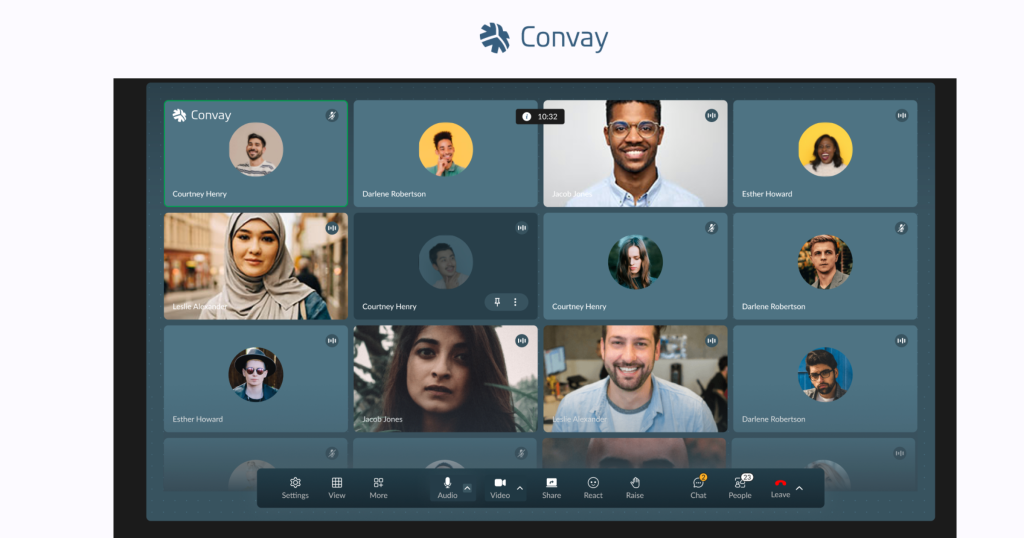
alt=”Convay video conferencing interface – Zoom alternative for enterprise meetings”
1. Convay — Best for Enterprise, Government and Large-Scale Webinars
Convay is a secure video conferencing and collaboration platform built specifically for enterprise, government, and large-scale institutional events, offering sovereign deployment, GDPR-safe AI processing, and webinar support for more than 10,000 participants.
Feature Convay Zoom Digital Sovereignty Full control over where meeting data is stored and processed Limited control depending on Zoom’s cloud infrastructure Confidentiality Chain Built-in confidentiality chain securing meetings with controlled access and full audit trails Not available Enterprise Security End-to-end encryption, AES-256, SSO-ready, full admin visibility through audit logs Enterprise security available but limited audit visibility End-to-End Meeting Management Complete lifecycle management including meeting preparation, hosting, and post-meeting collaboration Limited meeting lifecycle management In-Person Meeting Automation Tracks attendance, identifies speakers, and automatically generates AI meeting minutes Available but limited automation features Large-Scale Meetings Supports meetings with up to 10,000 participants Supports large meetings with add-ons Video and Audio Quality High-fidelity video and audio with adaptive performance for unstable networks High-quality video and audio Collaboration Tools Built-in whiteboard, polls, breakout rooms, and annotations Built-in collaboration tools AI Capabilities Transcription, captions, summaries, and translation across multiple languages AI features available but limited depending on plan Pricing Starts at $10 Starts at $16.99
- Data sovereignty. Convay offers sovereign deployment options that allow organizations to host all meeting data within their own jurisdiction, under their own legal framework, with encryption keys the organization controls. This directly resolves the Cloud Act and GDPR conflict that affects all US-hosted platforms and makes Convay a viable choice in government procurement frameworks where US-owned tools are excluded.
- Large-scale webinar capabilities. Convay supports more than 10,000 simultaneous participants with moderated Q&A, live polling, real-time multi-language translation, and AI-generated captions. These capabilities are part of the core platform, not a separate paid add-on, and are designed for the moderation complexity and participant volumes of government townhalls, international conferences, and enterprise all-hands events.
- GDPR-safe AI processing. Convay’s AI transcription, meeting summaries, and action item extraction are processed within the organization’s authorized data boundary. This is a material distinction from platforms where AI processing occurs on shared US-hosted infrastructure regardless of where the video stream is routed.
- Confidentiality Chain architecture. Convay’s security model protects data across the entire meeting lifecycle, covering transmission, storage, AI processing, and access management rather than only the video stream itself.
- Governance controls. Administrators have full audit trails, recording lifecycle management, role-based access controls, and configurable data retention policies as standard capabilities, not enterprise-tier add-ons.
- Browser-based participation. All participants join directly from a browser link with no application download and no account creation required, which is critical for large public events where requiring software installation creates participant drop-off.
Convay is the right choice for government agencies, enterprises in regulated industries such as government finance, healthcare, and legal, NGOs running global events, and any organization that has received legal or compliance advice against using US-hosted cloud platforms for meeting data.
2. Cisco Webex — Best for US Federal Agencies and Defence Contractors
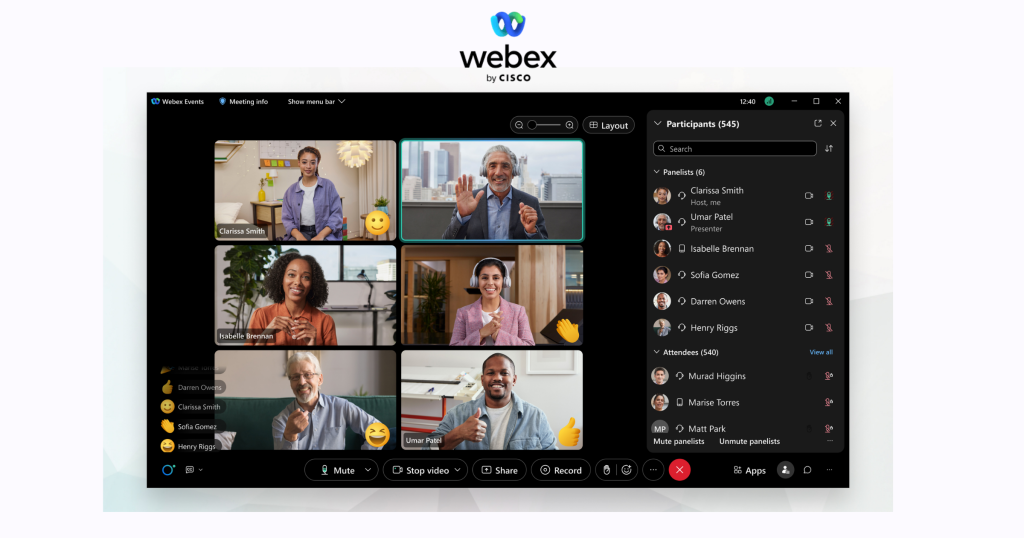
Cisco Webex is the standard enterprise video conferencing platform for US federal environments. It holds a Defense Information Systems Agency Provisional Authority to Operate at Level 5, which is one certification level higher than Zoom’s Level 4 clearance. For federal agencies and defense contractors where DISA authorization is a contractual requirement, Webex is the operationally correct choice.
Webex provides end-to-end encryption on enterprise accounts, large webinar hosting with analytics, deep integration with Cisco hardware infrastructure, and AI meeting assistance for transcription and summaries. Webinar capacity reaches 10,000 participants on enterprise tiers.
The important limitation for non-US organizations is that Cisco is a US-headquartered company subject to the Cloud Act. Webex faces the same jurisdictional conflict as Zoom for EU organizations evaluating data sovereignty compliance. The DISA Level 5 certification addresses US federal security requirements but does not resolve GDPR conflicts.
| Feature | Zoom | Cisco Webex |
|---|---|---|
| Best For | General meetings and webinars | Enterprise and US federal agencies |
| Maximum Participants | Up to 1,000 (10,000 with webinar add-on) | Up to 10,000 with enterprise plans |
| Security | AES-256 encryption, optional E2EE | End-to-end encryption with enterprise controls |
| Compliance | Limited for government environments | DISA Level 5 certified for US federal agencies |
| Browser Join | Available but limited features | Available, native app preferred |
| Webinar Tools | Requires paid webinar add-on | Built-in enterprise webinar tools |
| AI Features | Meeting summaries and transcription | AI meeting assistant and summaries |
| Best Choice | Small teams and general meetings | Government and enterprise security environments |
Webex also carries significant setup and administrative overhead for organizations that do not already run Cisco infrastructure, and pricing scales steeply at enterprise participant volumes.
Webex is the right choice for US federal agencies, defense contractors, and large US-based enterprises with existing Cisco infrastructure where DISA certification is a procurement requirement.
3. Microsoft Teams — Best for Microsoft 365 Organizations
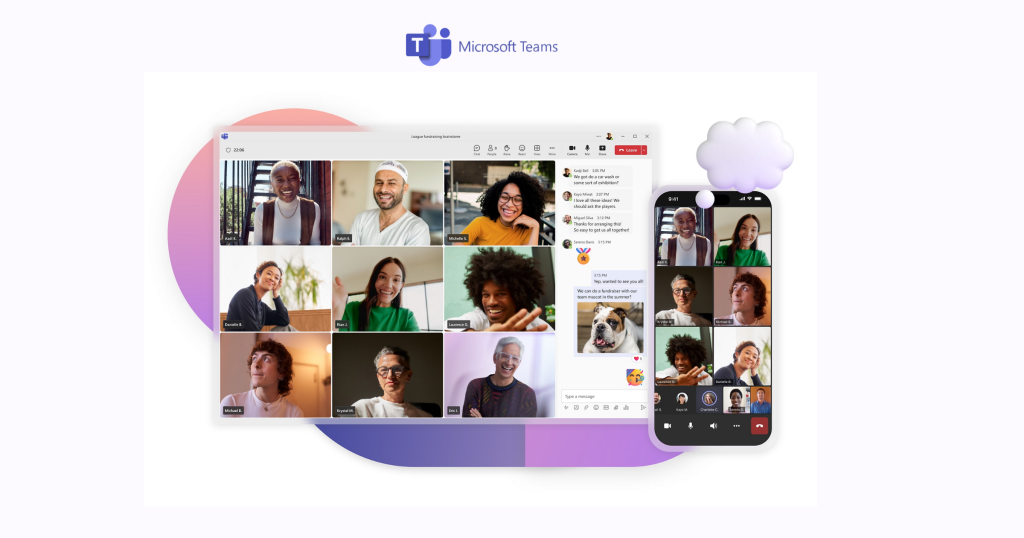
Microsoft Teams is a collaboration platform that includes video conferencing as one component of a broader Microsoft 365 integration layer. For organizations already committed to the Microsoft 365 ecosystem, Teams is the default choice because it requires no additional per-user cost and integrates directly with Outlook calendar, SharePoint, OneDrive, and the full Office suite.
Teams supports up to 10,000 participants in Town Hall mode, which makes it viable for large internal all-hands events. The Copilot AI features provide meeting transcription and summaries for organizations with Microsoft 365 Copilot licenses. Identity management through Azure Active Directory gives IT teams granular access control.
Teams is not a platform-agnostic solution, and its performance and value proposition depend heavily on Microsoft 365 adoption. For EU organizations evaluating Cloud Act exposure, Teams faces the same sovereignty conflict as Zoom — which is why France’s 2026 civil service migration includes Teams as one of the tools being replaced. For organizations that are evaluating an exit from Microsoft dependency, Teams is an obstacle to that goal rather than a solution.
| Feature | Zoom | Microsoft Teams |
|---|---|---|
| Best For | Standalone video meetings | Microsoft 365 collaboration ecosystem |
| Maximum Participants | Up to 1,000 | Up to 10,000 in Town Hall mode |
| Integration | Works with many apps | Deep integration with Microsoft 365 |
| Security | Standard enterprise security | Azure AD identity and compliance controls |
| Webinar Features | Paid webinar add-on | Built-in Town Hall events |
| AI Features | AI meeting summaries | Copilot AI meeting insights |
| Browser Join | Available | Available but limited features |
| Best Choice | Flexible meeting platform | Organizations using Microsoft 365 |
Teams is the right choice for enterprises already running on Microsoft 365 that are not subject to data sovereignty requirements that conflict with Microsoft’s US-based data processing.

4. Google Meet — Best for Simplicity and Google Workspace Teams
Google Meet is the simplest available Zoom alternative for teams already using Google Workspace. It is fully browser-based, requires no download, and is embedded directly in Gmail and Google Calendar. The free plan allows group calls up to one hour, removing Zoom’s 40-minute free group meeting restriction. Google Meet is included at no additional cost in all Google Workspace subscriptions.
Google Meet is not designed for enterprise compliance or large public events. It does not support sovereign hosting options, has no meaningful webinar infrastructure for large external audiences, and provides no governance controls for regulated industries. Google’s data processing practices create the same Cloud Act and GDPR jurisdictional exposure as Zoom. For organizations that have received compliance guidance against US-hosted platforms, Meet is not an acceptable alternative — it is a lateral move to a different US-hosted platform.
| Feature | Zoom | Google Meet |
|---|---|---|
| Best For | Large meetings and webinars | Google Workspace teams |
| Maximum Participants | Up to 1,000 | Up to 1,000 with Workspace plans |
| Browser Join | Available | Fully browser-based |
| Integration | Many third-party integrations | Deep Gmail and Google Calendar integration |
| Security | AES-256 encryption | Google cloud security model |
| Webinar Support | Requires paid add-on | Limited large event capabilities |
| AI Features | AI summaries and transcription | Captioning and meeting notes |
| Best Choice | Event-focused meetings | Teams using Google Workspace |
Google Meet is the right choice for small to medium teams using Google Workspace that need frictionless internal meetings and are not operating under regulatory requirements that conflict with US-based data processing.
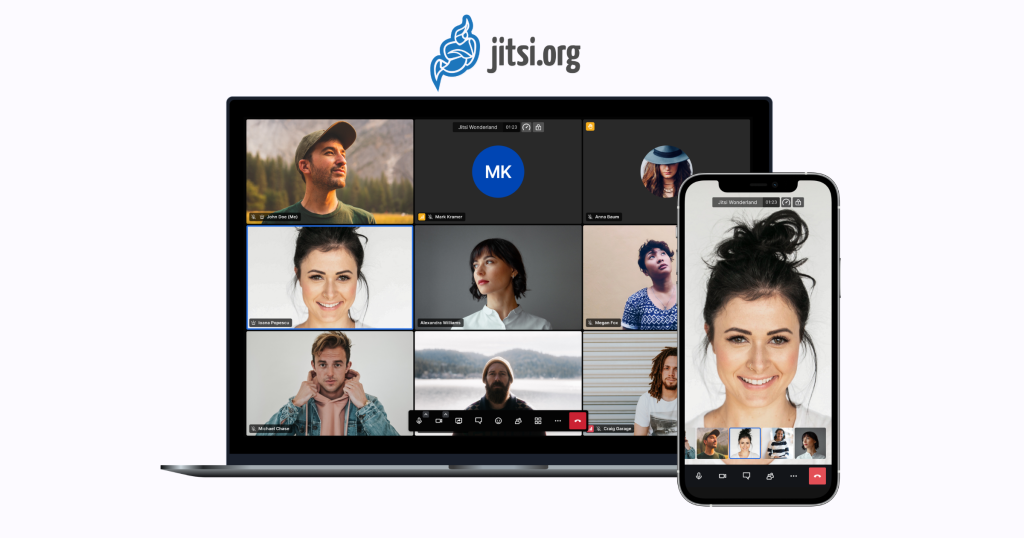
5. Jitsi — Best Open-Source Zoom Alternative for Technical Teams
Jitsi is a fully open-source video conferencing platform available under the Apache 2.0 license. For organizations with the technical resources to self-host, Jitsi provides complete infrastructure sovereignty with no vendor data processing and no jurisdictional exposure to any national law other than the one governing the organization’s own infrastructure.
| Feature | Zoom | Jitsi |
|---|---|---|
| Best For | Commercial meetings and webinars | Open-source self-hosted meetings |
| Cost | Free tier with limitations | Completely free if self-hosted |
| Maximum Participants | Up to 1,000 | Depends on server infrastructure |
| Deployment | Zoom cloud | Fully self-hosted |
| Security | Optional end-to-end encryption | End-to-end encryption by default |
| Browser Join | Yes | Yes |
| AI Features | Available | Not available |
| Best Choice | Managed cloud meeting platform | Privacy-focused self-hosted deployment |
Participants join from a browser link with no application required and no account creation. There are no time limits, no per-user fees, and no external AI processing of any kind. The organization’s own servers govern everything.
The trade-off is operational. Jitsi requires DevOps capability to deploy, secure, maintain, and scale. Enterprise governance features, built-in AI meeting intelligence, and large-scale webinar moderation tooling are not available out of the box. For organizations without a dedicated IT infrastructure team, the operational overhead is significant.
Jitsi is the right choice for technical teams, universities, national government agencies that require full infrastructure sovereignty, and privacy-first organizations that have IT resources to operate a self-hosted deployment.
6. OpenTalk — Best European Sovereign Zoom Alternative
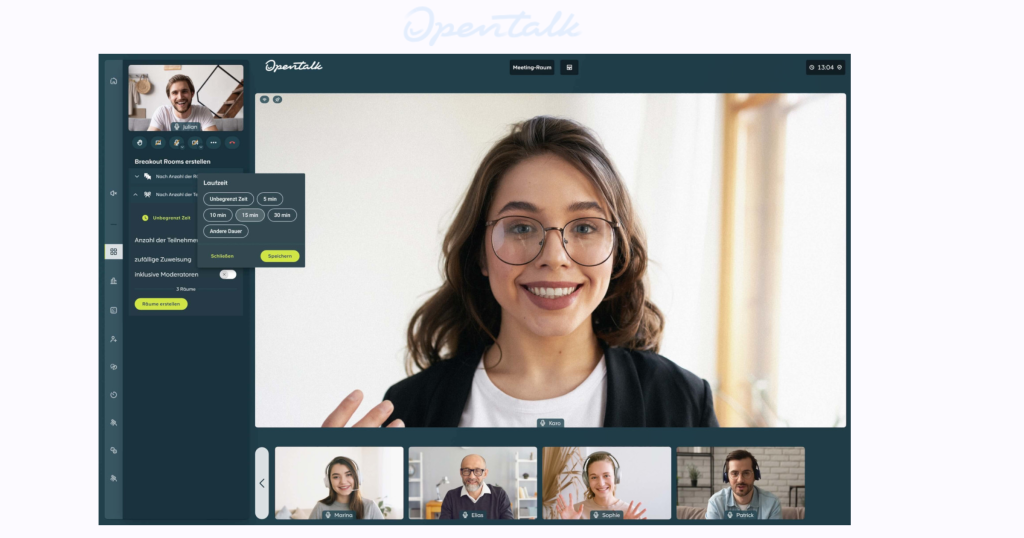
OpenTalk is a GDPR-native, open-source video conferencing platform developed in Germany specifically for the European public sector and regulated enterprises. It is designed to meet the sovereignty and compliance requirements that drove France’s 2026 civil service migration, and it is included in the European alternative ecosystem that governments across the EU are evaluating as replacements for US-hosted tools.
OpenTalk can be self-hosted on national or regional cloud infrastructure, giving organizations complete control over their data under EU law with no dependency on US-owned services. End-to-end encryption is the default, not an option. The platform is built for institutional use including public administration meetings, university environments, and regulated industry collaboration.
| Feature | Zoom | OpenTalk |
|---|---|---|
| Best For | General business meetings, webinars, and global teams | European public sector, universities, and privacy-focused organizations |
| Deployment | Cloud-based SaaS platform | Self-hosted, private cloud, or EU cloud deployment |
| Maximum Participants | Up to 1,000 (10,000 with webinar add-on) | Typically several hundred depending on infrastructure |
| Data Sovereignty | Limited control over data jurisdiction | Full control when self-hosted within EU infrastructure |
| Security | AES-256 encryption with optional end-to-end encryption | Strong security with default end-to-end encryption |
| Compliance | Standard enterprise compliance | Designed for strict GDPR and EU data protection requirements |
| Features | Screen sharing, recording, webinars, integrations | Whiteboard, voting, breakout rooms, moderation tools |
| Ease of Use | Very easy for general users | Requires more technical setup for self-hosting |
| Pricing | Free tier with paid plans | Free open-source version with enterprise options |
OpenTalk’s limitation compared to Convay is feature maturity at the enterprise scale. Its AI meeting intelligence and large-scale webinar tooling are less developed than platforms with longer enterprise product histories. It is a strong choice for organizations that prioritize open-source transparency and EU sovereignty above feature richness.
OpenTalk is the right choice for European public sector bodies, EU-based regulated enterprises seeking fully sovereign open-source deployment, and organizations in Germany and the EU that are directly responding to the same regulatory pressures that drove the French government’s 2026 decision.

7. Pexip — Best for Regulated Enterprise with Hybrid Infrastructure
Pexip is a Norwegian-built video conferencing platform used by government agencies and regulated enterprises across Europe and internationally. It is specifically designed for organizations with complex infrastructure requirements, including environments where some participants connect from legacy hardware-based video conferencing systems alongside modern software clients.
Pexip supports deployment in private cloud, on-premise, and government-certified cloud environments. It provides native interoperability with hardware video conferencing systems that are common in government and large enterprise installations, which is a capability most modern SaaS platforms do not offer. Its data residency options support EU jurisdiction requirements and it is used by defense, healthcare, and public sector organizations across Europe and the US.
| Feature | Zoom | Pexip |
|---|---|---|
| Best For | General business meetings and webinars | Regulated enterprises and hybrid infrastructure |
| Deployment | Cloud-based SaaS platform | Private cloud, on-premise, or hybrid deployment |
| Maximum Participants | Up to 1,000 (10,000 with webinar add-on) | Scales depending on enterprise infrastructure |
| Interoperability | Works best within Zoom ecosystem | Connects multiple systems including Teams, Zoom, and hardware video rooms |
| Security | AES-256 encryption with optional end-to-end encryption | Enterprise security with flexible deployment and compliance control |
| Data Sovereignty | Limited control over hosting location | Organizations can control hosting and jurisdiction |
| Hardware Integration | Limited support for legacy room systems | Designed to integrate with existing enterprise video hardware |
| Ease of Use | Very user-friendly interface | More complex, enterprise-focused platform |
| Pricing | Free plan available with paid tiers | No free tier, enterprise pricing |
Pexip’s primary limitation is pricing. There is no free tier and the platform is priced for enterprise procurement budgets. The interface is less consumer-friendly than newer platforms, and it is optimized for organizations with existing video infrastructure investments rather than organizations starting fresh.
Pexip is the right choice for regulated European enterprises, government agencies with hardware video infrastructure, and organizations that require private cloud deployment with certified EU data residency.
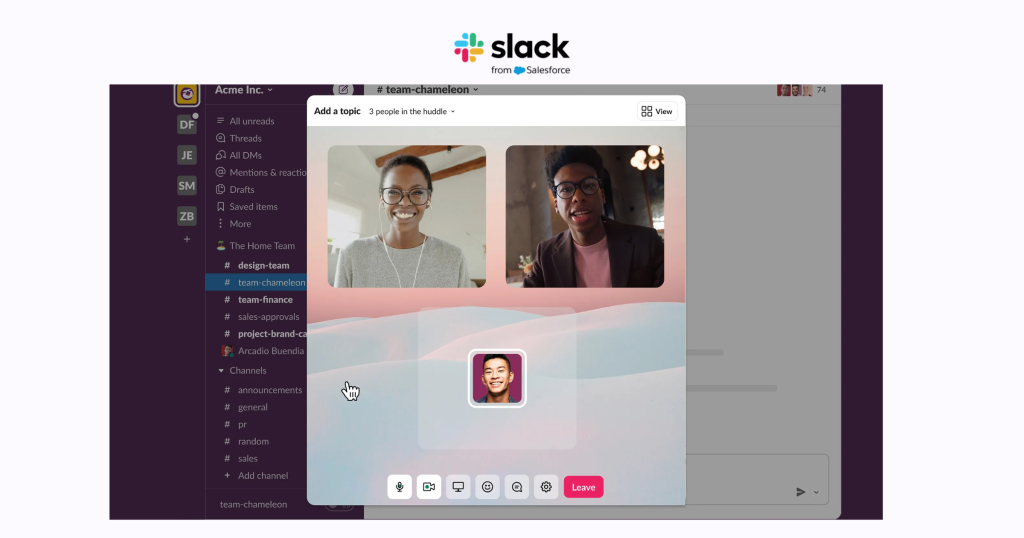
8. Slack Huddles — Best for Teams Already Using Slack
Slack Huddles is a lightweight video and audio calling feature built into the Slack messaging platform. It is not a standalone video conferencing solution — it is a low-friction way for teams that already communicate in Slack to move from text to a quick audio or video call without switching applications.
| Feature | Zoom | Slack Huddles |
|---|---|---|
| Best For | Formal meetings and webinars | Quick team conversations |
| Maximum Participants | Up to 1,000 | Up to 50 |
| Video Conferencing | Full video meeting platform | Lightweight audio/video calls |
| Webinar Support | Yes | No |
| Integration | Many integrations | Native inside Slack channels |
| Governance | Enterprise meeting management | Limited meeting controls |
| Best Choice | Structured meetings and events | Quick internal team communication |
Huddles support screen sharing, emoji reactions, and casual real-time conversation within Slack channels. They are designed for informal internal communication, not formal meetings, large events, or external-facing sessions. There is no webinar support, no governance tooling, no AI meeting summaries unless a third-party app is connected, and no enterprise compliance controls beyond what Slack itself provides.
Slack Huddles is the right choice for teams that already use Slack as their primary communication platform and want to reduce context-switching for quick internal calls. It is not appropriate for organizations looking for a serious Zoom replacement for structured meetings, external events, or regulated environments.
Detailed Feature Comparison
The descriptions in this table are written to explain the actual capability, not rate it with vague labels or single checkmarks.
| Capability | Convay | Cisco Webex | Microsoft Teams | Google Meet | Jitsi | OpenTalk | Pexip | Slack Huddles |
|---|---|---|---|---|---|---|---|---|
| Maximum participants | 10,000 or more | 10,000 on enterprise tier | 10,000 in Town Hall mode | 1,000 on paid Workspace tier | Limited by self-hosted infrastructure | Limited by self-hosted infrastructure | Scales with private cloud deployment | 50 participants maximum |
| End-to-end encryption | Default on for all sessions | Default on enterprise accounts | Available but not default | In-transit only | Default on all calls | Default on all calls | Default on all calls | In-transit only |
| Sovereign or on-premise deployment | Available as a core offering | Limited government cloud options | Not available | Not available | Fully self-hosted | Fully self-hosted or EU cloud | Private cloud and on-premise | Not available |
| Data jurisdiction | Organization-controlled jurisdiction | US jurisdiction, Cloud Act applies | US jurisdiction, Cloud Act applies | US jurisdiction, Cloud Act applies | Organization’s own infrastructure | EU jurisdiction, GDPR-native | EU or organization’s jurisdiction | US jurisdiction, Cloud Act applies |
| AI meeting summaries | Included, processed within data boundary | Included on paid plans | Requires Microsoft 365 Copilot license | Limited auto-notes only | Not available natively | Not available natively | Not available natively | Not available natively |
| Real-time translation | Included, multiple languages | Available on enterprise plans | Requires Teams Premium license | Caption translation only | Not available | Not available | Not available | Not available |
| Audit logs and compliance | Full audit trail, standard | Full audit trail on enterprise | Available through Microsoft Purview | Limited | Not available natively | Available on self-hosted deployments | Available on enterprise deployments | Limited |
| Browser-based for all participants | Yes, no download required | Partial, native app preferred | Native app required for full features | Yes, no download required | Yes, no download required | Yes, no download required | Yes for modern clients | Yes, within Slack |
| Government procurement suitability | Suitable for EU and international frameworks | High for US federal, DISA Level 5 | Contested in EU, suitable for US | Low | Suitable where self-hosted is acceptable | Specifically designed for EU public sector | Suitable for EU and regulated environments | Low |
| Free plan | Yes, unlimited seats, no group time cap | Yes, up to 100 participants | Included with Microsoft 365 subscriptions | Yes, up to 1 hour for group calls | Fully free, no limits | Open source, self-hosted | No free plan | Included with Slack free tier |
Which Platform Is Right for Your Organization?
Choose Convay when your organization is a government agency, a regulated enterprise in finance, healthcare, legal, or energy, or an institution running large-scale public events with thousands of participants. Choose Convay when your legal or compliance team has raised questions about Cloud Act exposure, when GDPR compliance for meeting data is a board-level requirement, or when you need AI meeting intelligence that does not create new regulatory exposure by processing transcripts outside your jurisdiction.
Choose Cisco Webex when your organization is a US federal agency or defense contractor where DISA Level 5 certification is a contractual requirement, or when you already operate significant Cisco hardware infrastructure and want deep ecosystem integration.
Choose Microsoft Teams when your entire organization runs on Microsoft 365, you are not planning to exit that ecosystem, and you are not subject to data sovereignty requirements that conflict with Microsoft’s US-based data processing.
Choose Google Meet when your team is small to medium in size, already uses Google Workspace, and needs simple frictionless internal meetings without compliance constraints.
Choose Jitsi when you have the DevOps capability to self-host, require complete infrastructure sovereignty, and are prepared to forgo managed AI features and enterprise governance tooling in exchange for zero vendor data dependency.
Choose OpenTalk when your organization is a European public sector body or EU-regulated enterprise that requires open-source, GDPR-native, sovereign deployment and is willing to accept a less mature feature set in exchange for EU data jurisdiction and open-source auditability.
Choose Pexip when your organization has existing hardware video infrastructure, requires private cloud or on-premise deployment, and has a procurement budget for an enterprise-grade platform with EU data residency.
Choose Slack Huddles when your team communicates primarily through Slack and needs lightweight internal calls without switching applications, and formal meeting management, webinar support, and external participant access are not requirements.
Frequently Asked Questions
What is the best Zoom alternative in 2026?
The best Zoom alternative in 2026 depends on the organization’s requirements. Convay is the strongest choice for enterprise and government organizations that require data sovereignty, GDPR compliance, and large-scale webinar support. Cisco Webex is best for US federal agencies requiring DISA Level 5 certification. Microsoft Teams is best for organizations already committed to the Microsoft 365 ecosystem. Google Meet is best for small teams using Google Workspace. Jitsi and OpenTalk are the best options for organizations that require fully sovereign open-source self-hosted deployment.
Why are so many organizations moving away from Zoom in 2026?
Organizations are moving away from Zoom in 2026 for three primary reasons. First, the legal conflict between the US Cloud Act and GDPR makes all US-hosted video conferencing platforms problematic for EU organizations, since the Cloud Act allows US authorities to access data stored anywhere in the world, including EU servers. Second, enterprise and government organizations need webinar platforms that perform reliably at thousands of participants with proper moderation and event tooling, and Zoom’s webinar capabilities require expensive premium tiers. Third, the total cost of Zoom when AI features and compliance add-ons are included is significantly higher than the headline price.
Is there a GDPR-compliant alternative to Zoom?
GDPR-compliant Zoom alternatives exist but the term requires precise definition. Platforms that avoid the Cloud Act conflict entirely include Convay with sovereign deployment, self-hosted Jitsi, OpenTalk on EU infrastructure, and Pexip on EU private cloud. These options keep all data processing within EU jurisdiction under EU law, eliminating Cloud Act exposure. Platforms such as Google Meet and Microsoft Teams have GDPR compliance programs but are still subject to the Cloud Act as US-owned companies, which creates a conflict that compliance agreements alone cannot resolve.
What is the best video conferencing platform for government agencies?
For EU government agencies, Convay with sovereign deployment is the most appropriate option because it supports national cloud or on-premise hosting with encryption key control and full audit trails. OpenTalk is specifically designed for European public administration and is GDPR-native. For US federal agencies, Cisco Webex holds DISA Provisional Authority to Operate at Level 5 and is the standard procurement choice. For agencies requiring full infrastructure independence, self-hosted Jitsi eliminates all vendor dependency. France’s January 2026 decision to migrate 2.5 million civil servants away from Zoom, Teams, Webex, and GoTo Meeting by 2027 illustrates the direction government procurement is moving globally.
Which Zoom alternative supports large webinars with thousands of participants?
Convay supports more than 10,000 participants with moderated Q&A, live polling, real-time multi-language translation, and AI captions included as core platform features. Cisco Webex and Microsoft Teams both support 10,000 participants at their enterprise tiers, with webinar tooling available as paid modules. The meaningful distinction is whether large-scale webinar support is a primary design capability, as it is with Convay, or a secondary feature added to a meeting-first platform, as it is with Webex and Teams.
What Zoom alternative works without requiring participants to download software?
Convay, Google Meet, Jitsi, and OpenTalk are all fully browser-based. Participants join by clicking a link in any modern browser with no application download and no account creation required. This is operationally important for large public webinars and government events where requiring attendees to install software significantly reduces participation rates and increases support overhead.
Is there a free Zoom alternative without the 40-minute group meeting restriction?
Convay’s free plan includes unlimited seats with no time cap on one-on-one meetings. Google Meet allows free group calls up to one hour. Jitsi and OpenTalk are completely free with no time limits on self-hosted deployments. All four offer more generous free tiers than Zoom’s 40-minute restriction for group meetings.
How does Convay compare to Zapier’s top-listed Zoom alternatives?
Zapier’s list of Zoom alternatives focuses on tools for general team use, including Slack Huddles and Discord, which are designed for informal communication rather than institutional meetings. The tools Zapier evaluates most favorably — Webex, Google Meet, and Teams — are US-hosted platforms that face the same Cloud Act and GDPR jurisdictional conflict as Zoom. Zapier’s evaluation criteria do not include data sovereignty, GDPR compliance, government procurement suitability, or large-scale webinar performance at institutional volumes. Convay is optimized for precisely the requirements that Zapier’s list does not address: sovereign deployment, regulatory compliance, AI processing within organizational data boundaries, and large-event infrastructure for thousands of participants.
Conclusion
Zoom remains one of the most widely used video conferencing platforms, but many organizations are now evaluating alternatives that offer stronger security, better compliance controls, and infrastructure designed for large-scale events.
The best Zoom alternatives in 2026 include **Convay, Cisco Webex, Microsoft Teams, Google Meet, Jitsi, OpenTalk, Pexip, and Slack Huddles**. Each platform serves a different type of organization. Enterprises and government agencies often prioritize data sovereignty, governance controls, and large webinar capacity, while smaller teams may focus on simplicity and cost.
For organizations running **large webinars, regulated meetings, or public-sector collaboration**, platforms designed with compliance and scalability in mind — such as Convay, Pexip, or OpenTalk — provide capabilities that traditional meeting tools were not originally built for.
Ultimately, the right Zoom alternative depends on your organization’s **security requirements, deployment preferences, and event scale**. Evaluating these factors carefully will help ensure your collaboration platform supports both operational needs and long-term compliance requirements.
