
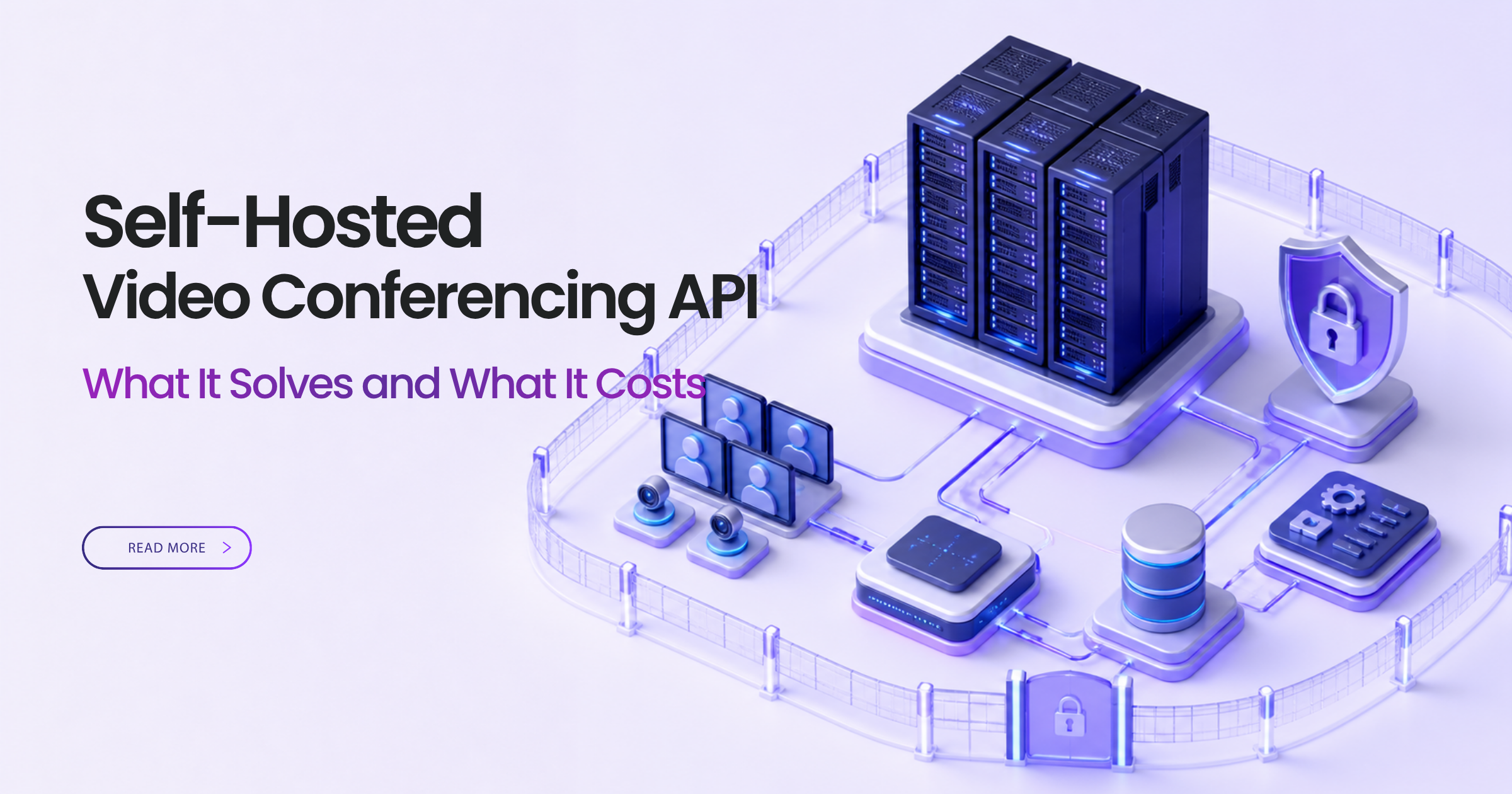
TL;DR: A self-hosted video conferencing API runs on infrastructure you control, so meeting data never reaches a third party and no foreign government can compel access to it. There are two routes: operate an open-source stack yourself, or deploy a commercial platform on-premise. The second keeps the sovereignty benefit without requiring in-house WebRTC engineers.
Self-hosting is usually raised for the wrong reason and adopted for the right one.
Teams tend to first consider it to reduce licence costs, then discover the operational bill. The teams that actually go through with it are almost always solving a different problem: a regulator, a ministry, or a security policy that says meeting data must not leave infrastructure the organisation controls.
That is a requirement no cloud region satisfies, at any price. This guide covers what self-hosting genuinely solves, the two routes to it, and how to tell which one you need.
Table of Contents
ToggleWhat is a self-hosted video conferencing API?
It is a video meeting platform, and its API, running on servers your organisation controls, whether in your own datacentre or your own cloud tenancy. Media, recordings, and metadata stay inside that boundary. No third-party vendor processes the data, so no external party can be compelled to hand it over.
The API surface looks the same as a hosted service. You authenticate, create meetings, distribute join links, and end sessions. The difference is entirely in where those requests are served and where the resulting data rests.
Air-gapped deployment is the strictest version, where the system has no internet connectivity at all. Defence and intelligence environments sometimes require it, and it rules out every cloud option by definition.
Why does self-hosting solve sovereignty when regional hosting does not?
Because residency and sovereignty are different questions. Regional hosting controls where data physically sits. Sovereignty concerns which government can compel access to it. A US-headquartered provider remains reachable under the CLOUD Act regardless of which region stores the data.
This is the point procurement teams grasp before engineering teams do, and it is a real legal distinction rather than a marketing one. A vendor can truthfully promise your data stays in a specific country while remaining subject to lawful production orders elsewhere.
The regulatory direction is one-way. The EU AI Act reaches full enforcement in August 2026 with penalties up to 35 million euro or 7 percent of global annual revenue, stacking on existing GDPR exposure. EU buyers increasingly disqualify tools that cannot demonstrate Schrems II compliance rather than negotiating. The same analysis notes Gartner expects sovereign cloud infrastructure spending to reach 80 billion dollars in 2026, up 35.6 percent year on year.
Self-hosting closes the question because there is no third party in the chain to compel.
Open source or commercial on-premise?
| Open source, self-run | Commercial on-premise | |
|---|---|---|
| Licence cost | None | Yes |
| You operate | Media servers, TURN, scaling, patching | Infrastructure, with vendor support |
| Specialist staff | WebRTC expertise required | Standard infrastructure skills |
| Accountability | Yours entirely | Contractual, with a vendor |
| Sovereignty achieved | Yes | Yes |
The bottom row is what matters, and both routes deliver it. The choice is therefore about who carries the operational burden and who is accountable when a session fails during a cabinet meeting.
Analysis of self-hosted deployments finds repeatedly that the cheapest tools by licence cost become the most expensive once engineering time is counted. Running production video means media servers, relay infrastructure, monitoring, security patching, and on-call cover for a system that fails in real time.
Convay takes the second route through on-premise and white-label deployment, which is the basis of its digital sovereignty position. The API and encryption behave the same; the infrastructure is yours.
The question that usually decides it: would you rather your engineers maintained a media server, or built the thing your organisation actually exists to do?
Frequently Asked Questions
It is a video meeting platform and its API running on servers your organisation controls, either in your own datacentre or your own cloud tenancy. Media, recordings, and metadata remain inside that boundary, so no third-party vendor processes the data.
Often not. Regional hosting controls where data physically sits, but sovereignty concerns which government can compel access. A US-headquartered provider remains reachable under the CLOUD Act regardless of the hosting region, which is why many regulated buyers require self-hosting instead.
Not usually, once operations are counted. Self-hosting replaces per-minute or licence charges with servers, bandwidth, relay infrastructure, monitoring, patching, and specialist engineering time. Analysis of open-source deployments consistently finds the cheapest licences produce the highest total cost of ownership.
Both keep data inside your infrastructure. Open source has no licence fee but requires you to operate media servers, relay infrastructure, and patching with in-house WebRTC expertise. Commercial on-premise charges a licence and leaves the vendor accountable for the product working.
A deployment with no internet connectivity at all, where the entire system runs inside an isolated network. Defence, intelligence, and some critical infrastructure environments require it. By definition it rules out every cloud-hosted option, so only self-hosted platforms can meet the requirement.
Related guides
- Start with the complete video conferencing API guide
- Weigh the open-source trade-offs in detail
- See why deployment ends Zoom evaluations
- Model hosted versus self-hosted cost
Does your policy require meeting data to stay in-house?
Tell us your regulatory constraints and infrastructure. We will show you what an on-premise deployment involves, what your team operates, and what stays our responsibility.